

AI visibility has quickly become one of the most talked-about topics in digital marketing. But for independent professionals trying to understand why they appear or don’t appear in ChatGPT and other AI-powered search experiences, the conversation can quickly become confusing.
How much of this is genuinely new? How important are third-party mentions? Can ChatGPT actually tell you why it isn’t recommending you? And what should coaches and wellness professionals work on before investing in the latest AI optimisation tactic?
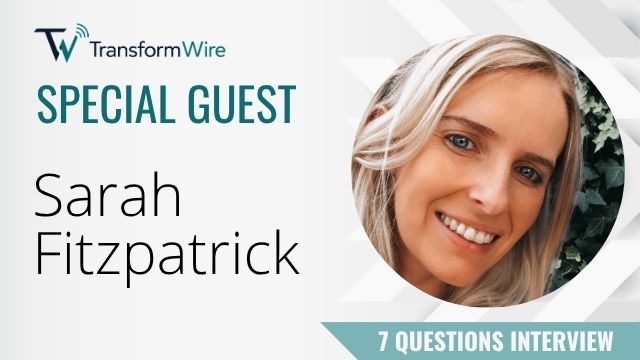
For this edition of 7 Questions With Transform Wire, we spoke with Sarah Fitzpatrick, an independent SEO and AI Search consultant with more than a decade of experience across agency, in-house and start-up environments.
Based in Ireland and working with clients internationally, Sarah helps brands improve their visibility across traditional and AI search while making SEO easier to understand. Her work spans technical SEO, content strategy, international search and AI visibility.
In this interview, she explains why AI search does change some of the rules but also why clarity, authority, consistency and trust still matter far more than many of the newest acronyms might suggest.
1. There’s suddenly an entire industry emerging around “AI visibility” and GEO. How much of this is genuinely new, and how much is good SEO, clear positioning and authority building under a new name?
There are genuinely new things to learn, but I think the industry sometimes makes AI visibility sound far more mysterious than it needs to be.
People are searching differently. Instead of typing a few keywords into Google and choosing from ten blue links, they can ask ChatGPT or another AI tool a very specific question and get one direct answer. That changes how we think about visibility, because being mentioned or recommended can matter just as much as ranking a webpage.
But the foundations and the questions you ask yourself are very familiar.
Can search engines access your website? Is it obvious what you do? Do you answer the questions your customers actually ask? Do you have genuine expertise and evidence to back it up? Are other credible websites and people talking about you? Is the information about your business consistent across the web?
That’s SEO, content, PR and brand building. We haven’t suddenly thrown all of that in the bin because somebody invented the acronym GEO.
There are new tactics and new ways to measure visibility, absolutely. But if someone is selling AI search as a completely separate form of marketing with a secret rulebook, I’d be VERY sceptical.
I wrote more about this in Why Is My Brand Not Showing Up In ChatGPT? because a lot of supposed “AI visibility problems” are really clarity, authority, accessibility or trust problems wearing a new hat.
2. You’ve written that brands may be missing from ChatGPT because of problems with clarity, consistency, authority, accessibility or trust. Do you see the same fundamentals applying when the “brand” is essentially one person and their expertise?
Absolutely. In some ways, I think they matter even more.
If the brand is one person, there is very little separation between the person, their reputation and the service they’re selling. An AI system needs to be able to understand fairly quickly: Who is this person? What do they actually do? Who do they help? What are they experienced in? And what evidence exists outside their own website that supports those claims?
That last part is important.
Anyone can write “leading expert” on their own homepage. It means a lot more when there are interviews, client testimonials, articles, professional profiles, event appearances, relevant directories or independent websites that consistently associate that person with their area of expertise.
Consistency also matters a lot too. If your website says you’re an executive coach, LinkedIn says leadership consultant, another profile calls you a wellness mentor and your Instagram bio says you’re helping people “step into their highest self”, humans might be able to piece that together. An AI system has a much messier job.
You don’t need to become robotic or use the same sentence everywhere. You just need a clear core identity.
For a personal brand, I’d probably sum it up as: make it easy for the internet to agree on who you are.
3. Coaches and wellness professionals often use broad language such as “transformation,” “empowerment” or “living your best life.” Can language that feels meaningful to their audience sometimes make it harder for search engines and AI systems to understand what they actually do?
Yes, and this is one of my favourite examples because it isn’t really an SEO problem. It’s a communication problem.
There is nothing wrong with words like transformation, empowerment or alignment if they genuinely mean something to your audience. The problem is when they replace the explanation of what you actually do.
Imagine landing on a homepage that says:
“Helping you unlock your potential, transform your life and become your most empowered self.”
Sounds lovely, but what are you selling?
Are you a career coach? A therapist? A nutritionist? A business mentor? A yoga teacher? A retreat company? Or even an SEO? (lol!)
Search engines and AI systems are trying to understand those same things. You can still have personality and emotion in your messaging. Just anchor it in something concrete.
One of the rules I come back to constantly in SEO is specific beats clever.
If somebody has to scroll halfway down your website before they understand what you actually do, ChatGPT probably isn’t the only thing you’re making life difficult for.
4. You’ve pointed to the importance of other people and websites talking about a brand. Why do third-party mentions matter, and does that make PR, interviews, directories and independent coverage more important in the age of AI search?
I think they are becoming increasingly important, but quality and relevance matter far more than collecting mentions for the sake of it.
Your own website tells the internet what you say about yourself. The wider web helps show whether anyone else agrees.
If I say on my website that I’m an expert in SEO and AI search, that’s one source making that claim. If I’m also interviewed about AI search, quoted in relevant articles, listed on credible professional websites and consistently associated with those topics elsewhere, there is a much stronger body of information connecting me with that expertise.
That matters to people too. We have always looked for reviews, recommendations, press coverage and other signs that a business is legitimate before trusting it.
AI hasn’t invented authority.
What it may have changed is how valuable that wider digital footprint becomes.
I would add one big warning though: this does not mean getting yourself listed on 300 rubbish directories or buying random “guest posts” because somebody promised you AI visibility.
One genuinely relevant interview can be worth far more than dozens of meaningless mentions.
I’ve written about this from another angle in What Ex Love Islanders Teach Us About Staying Relevant In Search. If you don’t keep building your own presence and giving other people reasons to talk about you, eventually somebody else’s version of your story becomes the easiest one to find.
5. If a business owner asks ChatGPT, “Why aren’t you recommending me?” and then follows the advice it gives, how seriously should they take that answer? Can AI reliably explain its own reasons for mentioning or not mentioning a particular business or expert?
This is a really important one.
ChatGPT can give you useful theories. It cannot give you a forensic explanation of why ChatGPT did something.
Those are two very different things.
If you ask, “Why didn’t you recommend my business?”, it might look at the information available across the world wide web and say your website lacks authority, you need more reviews or your positioning isn’t clear enough. Any of those things could be completely sensible advice.
But that doesn’t mean ChatGPT has opened up its own internal decision-making process and shown you the exact reason your name wasn’t included.
AI systems are very good at producing plausible explanations. That isn’t the same as having access to a neat little report saying:
“Sarah Fitz SEO missed this recommendation because Authority Score = 62. Please collect three more interviews.”
Unfortunately, life would be considerably easier for SEOs or business owners if that existed.
I’d use ChatGPT’s answer as a hypothesis, then you need to investigate it properly.
Look at which competitors are appearing. Benchmark their websites, content, reviews, mentions, authority and positioning with yours. Test multiple realistic questions rather than one prompt. Check whether the same pattern appears across different AI platforms.
That’s much more useful than repeatedly asking ChatGPT why it doesn’t like you until it gives you an answer you enjoy.
6. We’re already seeing services promising to get businesses “recommended by ChatGPT.” What should business owners and independent professionals be sceptical of when they encounter claims like that?
I’d be very wary of guarantees.
Nobody can ethically guarantee that ChatGPT will recommend your business for a particular question, never mind guarantee that you’ll permanently become its number one recommendation. ChatGPT visibility is very volatile and that means the responses you receive are constantly updating and evolving. No one can guarantee you that you will always appear.
There is no secret form where an SEO can submit your business to ChatGPT for approval and there isn’t a magic piece of schema that instantly unlocks AI visibility either.
And if somebody shows you one screenshot where their client appeared for one carefully chosen prompt, that doesn’t prove very much. AI answers can change depending on the wording of the question, context, location, platform and when you ask.
I’d want to know what they’re actually going to do.
Are they improving the website? Fixing technical problems? Making the company’s positioning clearer? Creating genuinely useful content? Improving important service pages? Building credible third-party mentions? Strengthening reviews and community mentions? Measuring visibility across a sensible group of questions? If so, great.
Or are they essentially charging you to repeatedly ask ChatGPT your company name and create a dashboard with lots of colourful graphs? Awful.
Businesses should also be sceptical of anyone pretending they have completely cracked an algorithm that even the companies building these systems are continuously changing.
Good AI search work should make your whole organic presence stronger across all search platforms, not leave you with a collection of tricks that only work for a carefully curated handful of ChatGPT prompts. That isn’t a realistic picture of how your actual customers search.
7. If you applied what you’ve learned from working across SEO and AI search to an experienced coach or wellness professional with a decent website but almost no AI visibility, what would you tell them to work on first?
Before I touched anything complicated, I’d look at their website and ask one brutally simple question:
Can I understand exactly what this person does in about ten seconds?
If not, I’d fix that first.
I’d make the homepage and key service pages very clear about what they offer, who they work with, the problems they help solve and why they’re qualified to do it.
Then I’d look at proof.
Are there proper testimonials? Case studies? Qualifications? Results? Media mentions? Interviews? Professional profiles? Does the rest of the internet tell roughly the same story about this person as their website does?
Next I’d look at the questions potential clients are actually asking. Not just “What is wellness coaching?”, but things their audience would ask when getting closer to making a decision:
“Can a career coach help me return to work after burnout?”
“How do I choose an executive coach?”
“What happens in a coaching session?”
“Is coaching right for me?”
Those are the questions I’d want their website to answer properly.
Then I’d make sure the site is technically accessible and start measuring AI visibility across a group of relevant questions rather than obsessing over one vanity prompt.
I wouldn’t begin by chasing some obscure AI optimisation hack.
I’d begin by making the person ridiculously easy to understand, verify and trust across all search platforms.
That’s useful for ChatGPT and it’s also useful for Google.
More importantly, it’s useful for the actual human being deciding whether to give you their money.
To learn more about Sarah’s work and read more of her insights on SEO and AI search, visit Sarah Fitz SEO.