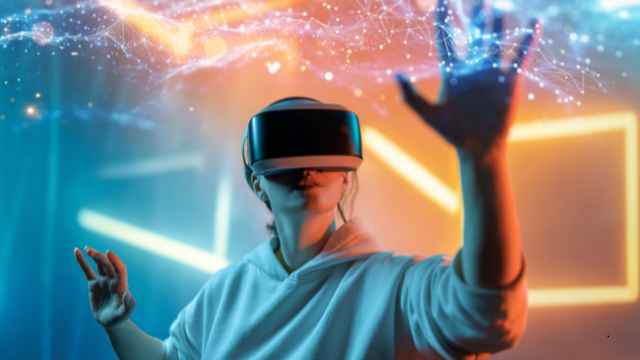

New research suggests that immersive technology can evoke feelings of unity, awe and altered consciousness. The surprising part is that the experience may depend less on what people see than on how they experience it.
What if a feeling of profound connection, the kind people sometimes describe after deep meditation or an extraordinary spiritual experience, could also arise inside a virtual world?
Researchers at Western University in Canada explored something remarkably close to this question. In an experiment involving 80 young adults, participants entered computer-generated environments while listening to guided exercises. Some followed a fantastical story, while others practiced a relatively ordinary breathing meditation.
The results were unexpected. In the virtual-reality conditions, 28% of participants following the imaginative journey and 18% of those practicing meditation met the researchers’ criteria for what they called a “complete mystical experience.” When the same exercises were presented on a conventional computer screen, nobody reached that threshold. The study, published online in May 2026 in Psychology of Consciousness, raises an intriguing possibility. Perhaps the sense of being immersed in an experience plays a larger role in unusual states of consciousness than we previously understood.
The participants entered virtual environments featuring landscapes such as islands and underwater scenes. In one version, a guided story included unusual images, including animal spirits emerging from a fire. In another, participants simply followed instructions to focus on their breathing. The researchers wanted to know whether extraordinary imagery was necessary to evoke mystical-type experiences, or whether the immersive environment itself could be enough.
Interestingly, there were relatively few differences between the two exercises. Even participants following the more conventional meditation reported powerful responses when using virtual reality. But what exactly counts as a mystical experience in scientific research?
The researchers used a questionnaire measuring four characteristics: a feeling of unity, changes in the perception of time and space, intense positive emotions, and the sense that an experience is difficult to describe in words. People who have practiced meditation for years may recognize some of these descriptions. There are moments when our ordinary awareness of ourselves and our surroundings seems to change. We may feel unusually peaceful, deeply connected or absorbed in an experience.
Of course, those experiences are not necessarily identical, and a questionnaire cannot establish their spiritual meaning. What makes this experiment interesting is that some participants reported several of these characteristics together while immersed in a computer-generated environment.
Does the experience depend on what we see or how we see it?
A second experiment, published in August 2026 in the journal Virtual Reality, adds another piece to the picture. Researchers Liat Abouhav, Keren Nitzan and Ravid Doron asked 70 participants to watch the same emotionally evocative short film. One group used virtual-reality headsets, while the other watched on ordinary computer screens. Those using VR reported significantly higher scores across all dimensions of the mystical-experience questionnaire.
This points to an interesting distinction. Watching something and feeling surrounded by it are not necessarily the same experience, even when the content is identical. Think about standing beside the ocean. You can watch a beautiful recording of waves on your phone, but actually being surrounded by the sound, movement and vastness of the sea may affect you quite differently.
Virtual reality creates another version of this relationship between perception and experience. The environment is artificial, but the emotions people report while immersed in it can be genuine.
What might this tell us about consciousness?
For people interested in spiritual growth, meditation and personal transformation, these findings invite a question that reaches beyond virtual reality. How much do our experiences depend on external circumstances, and how much on the way our awareness responds to them?
A beautiful landscape, a piece of music or a moment of deep meditation can affect two people very differently. One may experience something profound, while the other feels very little. The VR studies cannot explain all those differences. Nor do they demonstrate that the participants underwent lasting spiritual transformation. The researchers measured experiences occurring under particular experimental conditions, not changes in people’s lives afterward.
Yet the results are worth considering because they show how strongly the way we encounter something can influence what we experience. Perhaps the most interesting question is not whether technology can reproduce a mystical state, but what these experiments may eventually teach us about the conditions in which such states arise.
For now, we know that an immersive virtual environment can evoke powerful feelings of awe and unity in some people. What those experiences mean, and whether they have any lasting influence, remains open to further exploration.
Sources
- Miller, Nyland and Frewen — Mystical Experiences in Virtual Reality 2 (2026)
- Abouhav, Nitzan and Doron — Immersive Virtual Reality: Distinct Impact on Altered States of Consciousness (2026)